The Reboot Project

For the people with broken signalling, not broken souls.

Find out more Stay in touch
Who we are

Broken signalling works the same way at both ends of the system.

The Reboot Project works with two populations that mainstream services have consistently failed to reach — and that nobody else is currently working across from the same position.

The first: people who came of age in the nineties club and rave scene, still functioning, still going, but carrying thirty years of accumulated neurological and psychological damage with no language for what's actually wrong. Services were never designed for them. They don't join waiting lists. They manage — until they don't.

The second: young people in private and independent schools, where signalling failure is hidden by resource, explained away by pastoral systems, and managed privately until the consequences become impossible to ignore. Standard peer education fails here — not because the young people are unreachable, but because the peers they're given don't share their cultural grammar.

Our founder does. He moved through both worlds. That is not background detail.

It is the methodology.

Read the full story →
Cracked stone
Adam Palk
The Founder

Adam Palk

Adam Palk has spent over twenty-two years working across commercial management, frontline support services, and community development.

He began in business — running large teams, turning around loss-making operations. He moved into the community sector through Brighton Housing Trust, progressing from volunteer to full-time frontline worker across mental health care homes, emergency shelters, and crisis support.

He founded two charities in Brighton, and participated in the CGL Individual Placement and Support pilot — speaking alongside Dame Carol Black to the Health Minister at Richmond House to help make the case for national funding.

He is also a Shiplake College alumnus, now active in independent school networks — bringing the same peer-led methodology to young people in high-resource environments whose signalling failures are hidden by insulation rather than exposure.

He lives in Cranleigh, Surrey, with his wife. He is also writing a memoir.

The Reboot Project is his life's work. He has standing in both worlds. That is the point.

Read the full story →
What we do

Four strands. One mission.

01

Research and Development

Peer-led research into acquired brain injury, complex trauma, and addiction — for populations the system has never properly seen. Building the first evidence-based intervention frameworks for people who don't appear in clinical samples. The outreach funds the research. The research builds the case. The case changes the frameworks.

02

The Reboot Bar

A mobile hospitality unit — a converted horsebox — serving as a zero-barrier entry point. Pay-what-you-feel. No referral. No clipboard. A genuine social space, not a service. Social first. Intervention second — only when the person is ready to move toward it.

03

Retreats

One-to-one residential retreats as the primary income stream. Land, quiet, fire, time. No programme, no group, no performance expected. Based in the Surrey countryside. For individuals whose nervous systems have been running on high alert for too long — withdrawal from noise is not optional. It is the prerequisite.

04

School Engagement

Peer-led work within private and independent schools. Not another awareness programme. Direct engagement from someone who shares the cultural background — and who has been where those young people are heading. Research built in from the start. Same broken signalling. Different postcode.

The Retreat

No programme. No group. No clipboard.

You don't need another assessment. You need to get out.

The Reboot Retreat is a bespoke, one-to-one escape — stripped back to the essentials. Countryside. Quiet. Space to breathe and space to think, away from everything you've been managing.

Total privacy. No signage, no waiting rooms, no other guests. Just you, the land, and someone who's been where you've been.

This isn't treatment. It's something older than that — a return to source. Time offline, in the open air, with honest conversation and whatever you need to rest properly for the first time in years.

Add-ons are available — rhythm work and drumming, stripped-back music, somatic sessions, guided walks. Or nothing at all. You choose.

Fully bespoke — no fixed programme, no group sessions
One-to-one with a peer guide, not a clinician
Rural Surrey countryside — total discretion
Rhythm work, drumming, healing, or silence
Duration led by you — days or longer
Express early interest →
The retreat — countryside
1:1 Always private
0 Clipboards

We are currently looking for the right rural home for the retreat. If you have land or a building in Surrey, Sussex, or Hampshire — we'd like to talk.

Land & Space Partners

Give land a new purpose

The Reboot Project needs a home. We're looking for rural buildings, barns, and estate spaces in Surrey and the South East — places with character, quiet, and room to breathe.

We don't need much. A converted outbuilding, a farmstead, a walled garden with accommodation. Something that's been sitting underused while you work out what to do with it next.

We offer a reliable charitable tenancy, careful management, and a use that justifies itself — to your estate, your conscience, and possibly your accountant.

Talk to us →
80% Mandatory Business Rate Relief

Charitable occupation may make your property eligible for 80% mandatory rate relief — with the remaining 20% subject to discretionary top-up. For many landowners, this alone makes a conversation worth having.

What we're looking for

Rural or semi-rural setting — Surrey, Sussex, Hampshire, or Kent
Residential or semi-residential building with basic utilities
Space for small-group or one-to-one residential retreats
Minimum 3–5 acres, or a self-contained converted outbuilding
Open to medium or long-term charitable tenancy

Reliable tenancy

A professionally managed, low-impact charitable occupier. No noise, no damage, no ambiguity about what the space is for.

Rate relief

Qualifying charitable use may unlock up to 80% mandatory Business Rate Relief — with further discretionary relief potentially available from your local authority.

Documented impact

Full reporting on the community benefit generated by your land. Useful for planning applications, estate legacy, and stakeholder communications.

Reboot in Action: The Pilot

As the Trailer Was Restored,
So Was I

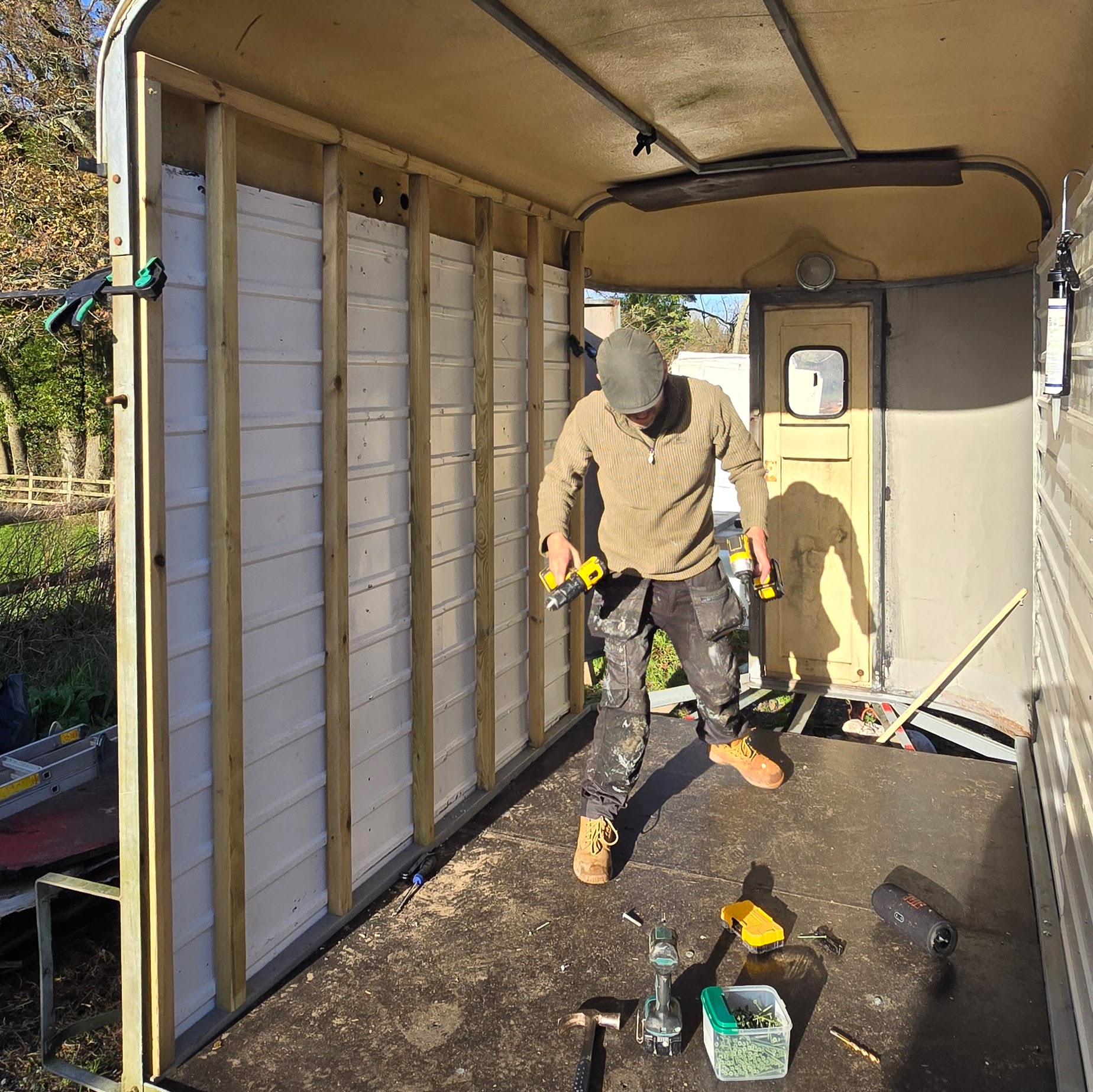
Adam inside the horsebox trailer during the build, drill in hand

I didn't plan it as a metaphor. I just needed something to do with my hands.

The horsebox arrived the way most things arrive when you're early in recovery — rough, stripped back, smelling of something you couldn't quite name. The bones were good. Everything else needed work. I looked at it for a long time before I picked up a tool.

That's how it starts. You just look at the thing. You take stock of what's actually there, not what you wish was there. You resist the urge to start ripping things out before you understand the structure.

Then you begin.
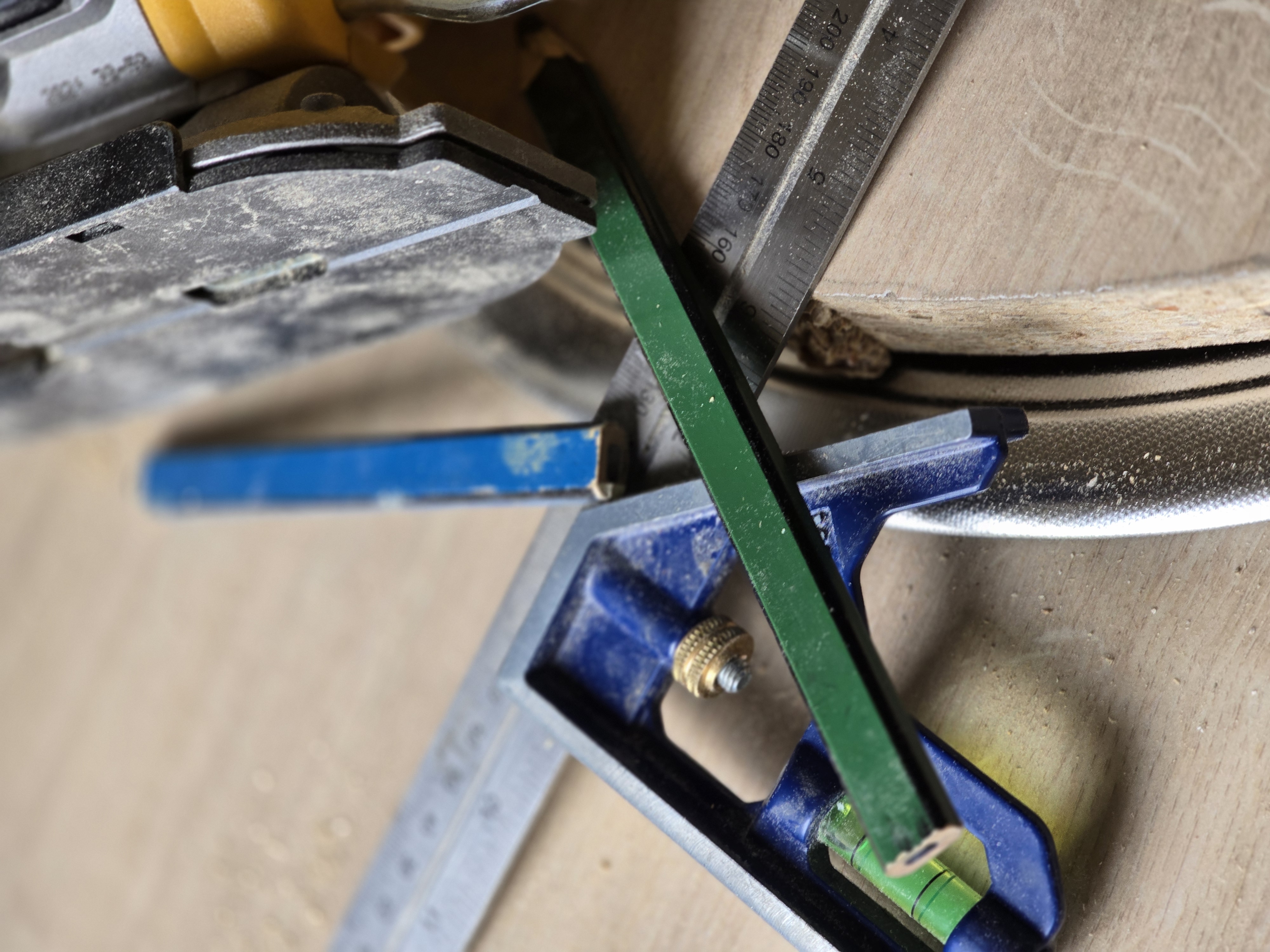
Measuring tools on the workbench — square, level, saw

The first thing you do in any restoration is establish what's level. Not what looks level. What actually is. Because you can build a beautiful interior on a crooked frame and it will tell on itself eventually — a door that won't close, a shelf that slides, a joint that opens under pressure.

Recovery works the same way. The early work isn't visible. It's the work underneath — getting honest about the frame, about what's actually crooked and what was always solid. Most people I know who've been through the system spent years having their surface patched and painted while the structure underneath was never touched. New labels on the same warped timber.

You can't reboot a system that's running on a corrupted baseline. You have to go to the hardware.
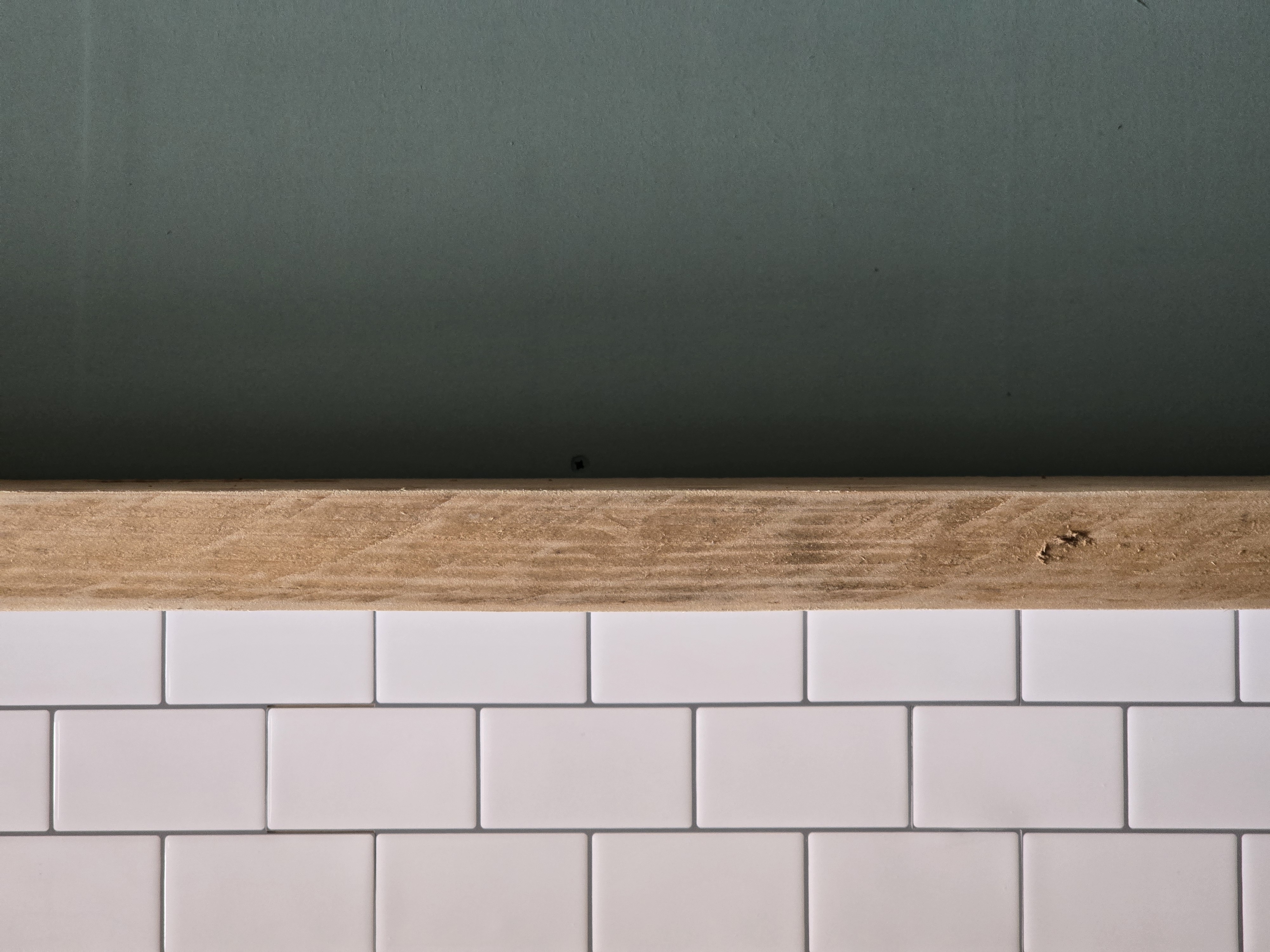
White subway tiles, oak ledge, sage green wall — the horsebox interior taking shape

There's a moment in any build when it stops looking like a wreck and starts looking like something. It doesn't happen dramatically. You're not standing back admiring progress — you're on your knees grouting tiles or sanding an edge, and you look up and the light is different and you realise: it's becoming what it was supposed to be.

I know when that moment happened with the horsebox. I know when it happened with me too. They weren't the same day, but they weren't far apart.

The tiles went in clean. The oak ledge sat level. The sage green — the colour of something living, something that grows in the right conditions — went up on the wall above. I stood back and thought: someone could be comfortable in here. Someone could breathe in here.

That was the point. That was always the point.

You don't need to be sober to work.
You need work to be sober.

Every recovery model I'd ever encountered had this backwards. Fix yourself first. Stabilise. Comply. Then — maybe, eventually — we'll talk about giving you something meaningful to do. Purpose as a reward for good behaviour.

But a brain that's been running on chaos, on substances, on thirty years of unmanaged neurological noise doesn't quieten down when you take away the stimulus. It screams. The chaos was never the problem — it was the solution. The only one available.

Give it something else. Give it a problem to solve, a thing to build, a standard to meet. Give it skin in the game.

The horsebox didn't care about my history. It cared whether the tile was straight.
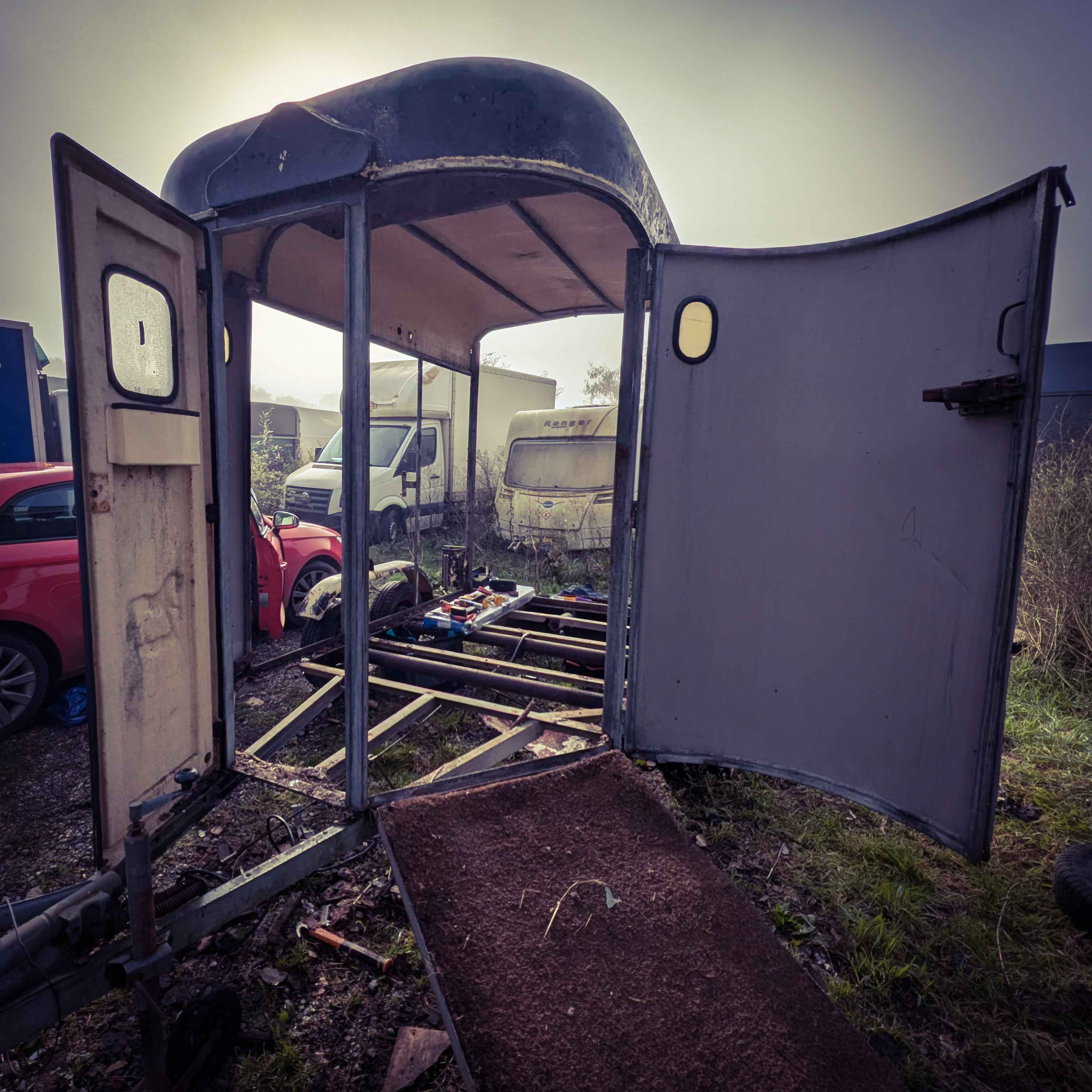
The horsebox interior framed out, light coming through, the space beginning to define itself

The pilot ran under the name Uplift. A mobile coffee unit — premium beans, proper technique, nootropic options for people who'd spent years self-medicating a nervous system that never got the support it needed. The training was built into the job itself, not bolted on as a programme. You learned because the standard required it. You showed up because the unit didn't open without you.

It worked. Not without difficulty — nothing at the pilot stage works without difficulty. But it worked in the ways that matter. People who weren't ready for recovery by anyone else's definition found that having somewhere to be, something to be responsible for, changed the internal weather. Not because someone told them it would. Because the work made it true.

A similar model ran at the Synergy Centre in Brighton — a 500-capacity community venue where weekend events cross-subsidised midweek work with people the system had largely written off. It worked there too. That model has since been replicated.

The idea isn't new. It just keeps getting buried under softer thinking.

The horsebox is nearly finished.

It started as a coffee unit. It's becoming something more — the prototype for The Reboot Project's retreat model. A portable space, low-threshold, designed to reach people where they are rather than waiting for them to present themselves somewhere clinical. You don't have to walk through a door that feels like defeat to get here. We come to you.

Everything in it was built by hand. Every tile set, every joint cut, every surface finished. By someone who needed the work as much as the work needed doing.

That's not a metaphor. That's just what happened.

As within, so without. The work begins inside.

The Reboot Project is currently in development. If this resonates — if you're someone who needs this, knows someone who does, or wants to help build it — get in touch.

Get in touch →

Valley view
Get Involved

Three ways in

Trustees

We are building our board. If you have skills in finance, law, mental health, communications, or fundraising — or lived experience and the belief that this matters — we want to hear from you.

Find out more →

Land & Space Partners

If you manage rural land or estate buildings in the South East and want to explore a charitable tenancy — with potential Business Rate Relief — we'd like to talk.

Find out more →

Community

If this is your world — if you recognise yourself or someone you know in what we're building — sign up to the newsletter. That's the start.

Sign up →

The map was always there. We just needed the right language to read it.

The Reboot Project